

Wellbeing at ACS
ACS is recognised as a leader in data-informed, student-led wellbeing. We have ‘grown’ our own leaders and built wider teams that integrate information and services to support students and build more responsive communities. Wellbeing is increasingly connected with belonging through close engagement with the schools’ DEIB initiatives.
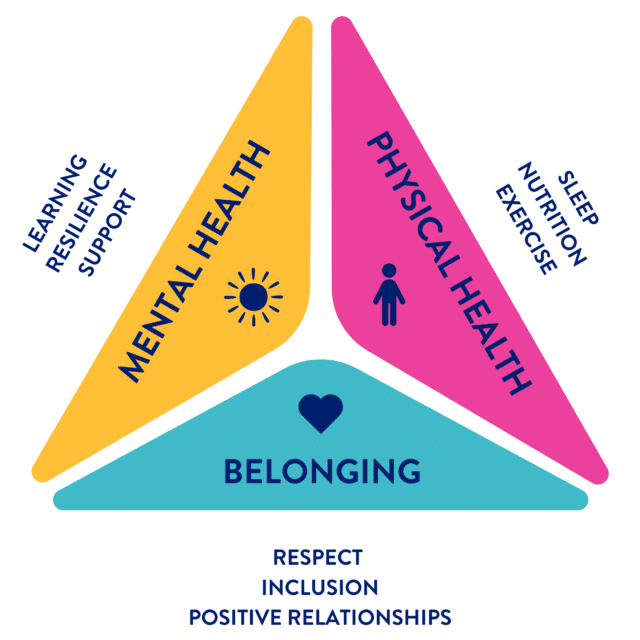
Our approach is student-led, beginning with student developed ACS Student Wellbeing Triangles and Student Wellbeing Champions on each campus. We continue to collaborate with a powerful network of expert partners and service providers, on a local, national, and international level. We continue to strengthen the infrastructure to support student wellbeing, building on the schools’ already-strong pastoral care and safeguarding programmes. We provide student support teams with a data-rich ecosystem that offers quick-cycle feedback, longitudinal comparison, and external benchmarking.

The ACS Wellbeing Strategy
2025-2030
Sitting alongside the ACS Education Strategy, the ACS Wellbeing Strategy fulfils our vision to create a safe, inclusive, and supportive school environment where every individual feels valued, connected, and equipped to flourish.
The Wellbeing Strategy is based on the whole-school approach to mental health and wellbeing outlined in theUK Government’s document ‘Promoting children and young people’s emotional health and wellbeing – a whole school and college approach’. The eight principles it identifies ensure that we continue to:
- Embed wellbeing into the curriculum and school culture
- Build student and staff capacity and resilience
- Provide targeted support for vulnerable students
- Engage families and community partners
- Utilise data to inform decision-making
Wellbeing Reimagined
From Trends to Transformation: ACS wellbeing initiatives for 2025 to 2030
We are continually monitoring trends and patterns across all areas of school wellbeing and in addition to the actions identified for implementation for each of the eight principles of the whole school wellbeing model, we have identified three key focus areas to guide our strategy over the next five years. Students will play an integral role in all future wellbeing initiatives, as they collaborate with staff to share ideas and co-produce strategies that enhance the student experience across ACS schools. Student involvement will help the children and young people at the schools feel they have ownership of these policies and initiatives and feel fully supported by them.
Brave Spaces
 Classroom and building design for wellbeing, belonging and inclusion
Management of mobile devices

Digital learning and AI
 Using AI tools to enhance learning on wellbeing across our school communities
There is seemingly no trade-off between wellbeing and academic performance. Put simply: happier young people make better learners.
Student Wellbeing
ACS Student Wellbeing Triangles

Wellbeing Ambassadors
Counselling Services
Mental Health
Monitoring
Personal, Social, Health & Economic (PSHE) Education
Wellbeing in and outside the classroom
Resources
Teacher wellbeing has a significant impact on the wellbeing and academic success of students.
Staff wellbeing
The Health and Safety Executive has noted teaching as a high-stress profession.
At ACS, our Human Resources team leads on wellbeing initiatives across all staff groups to ensure that managers are committed to helping all our staff understand the importance emotional health and wellbeing, learn about and use strategies and techniques to promote positive emotional health and wellbeing, and develop self-directed approaches to stress management.
ACS provides formal clinical supervision for Safeguarding, Counselling, and Pastoral Care staff who are responsible for supporting student mental health, as well as coaching and professional guidance from designated group leaders for Safeguarding and school nursing. Our Employee Assistance Programme is available to all ACS staff, providing 24/7 clinically-led guidance and Life Management support.
Resources
Family interactions are very impactful on the wellbeing of young people and, for children in particular, they are the most significant driver
Family wellbeing
Supporting student wellbeing is a partnership with parents and carers and is vitally important for the best care of the young people in the ACS community.
ACS recognises that our families want to support children’s mental health at home and ensures our parents can easily share concerns, and access information and ideas for positive mental health through our school support networks. Where appropriate, ACS supports families in accessing the support of outside providers.
Individual schools highlight sources of information and support about common health and wellbeing issues on the parent pages of their school intranet.
Parents are surveyed on the happiness of their child/ren at school as part of the ACS parent survey and all ACS families have access to The Wellbeing Hub, a trusted source of support designed by experts to meet the social, emotional, and educational needs of young people.