

13/08/2026
Newspaper founder and academic and leadership society President: two Hillingdon students win places at LSE after outstanding IB results
Tanisi Garg balanced founding a student newspaper, captaining the volleyball team and running a school society’s finances alongside one of the most demanding qualifications on offer. She scored 43 out of 45 in the International Baccalaureate – the equivalent of around five A* grades – and is off to the London School of Economics. Rudra Mathur made the brave decision to study four higher level subjects over the required three and achieved a score less than one percent globally get – 45 out of 45 and is also off to the London School of Economics.
Tanisi Garg has spent her sixth form doing rather more than her exams. Alongside the International Baccalaureate (IB) Diploma Programme (DP), she helped found The Hawk Eye, the school’s student newspaper, as its Creative Head, captained the volleyball team and served as treasurer of the National Honour Society, a US honour society that selects members on academic record, service, leadership and character. She scored 43 points out of 45 – the equivalent of around five A* grades at A-level – and will read Accounting and Finance at the London School of Economics.
Tanisi said: “I chose the IB because I wanted something challenging that would prepare me for university, and I liked that I didn’t have to narrow my studies too early. Balancing The Hawk Eye, volleyball and the National Honour Society with the demands of the IB wasn’t always easy, but it taught me to plan ahead, prioritise and ask for help when I needed it. Looking back, those experiences made me much more resilient.”
For Tanisi, the IB offered the academic challenge she was looking for while allowing her to develop interests and skills beyond the classroom.
Rudra Mathur took the unusual and demanding step of sitting four Higher Level subjects rather than the usual three. He was not sure what he wanted to specialise in at sixteen, and the breadth of the IB meant he did not have to decide too soon. He will now read Politics and Economics at the London School of Economics.
Rudra said: “If I went back to do it [IB] again, I would once again choose four Higher Levels. It meant I got depth in everything I cared about instead of having to pick a lane at sixteen. It challenged me in a positive way, greatly improved my time management and prepared me to prioritise and manage heavy workloads.”
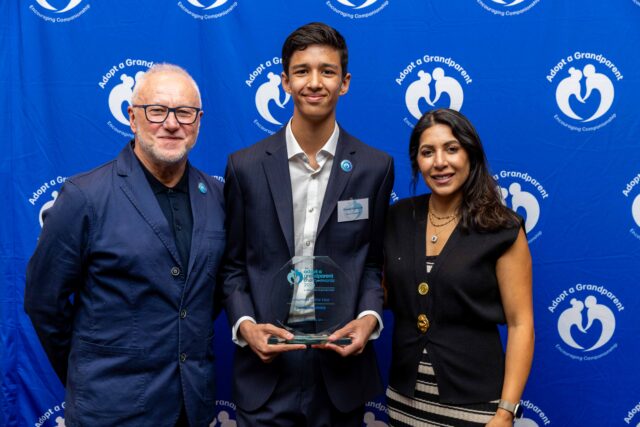
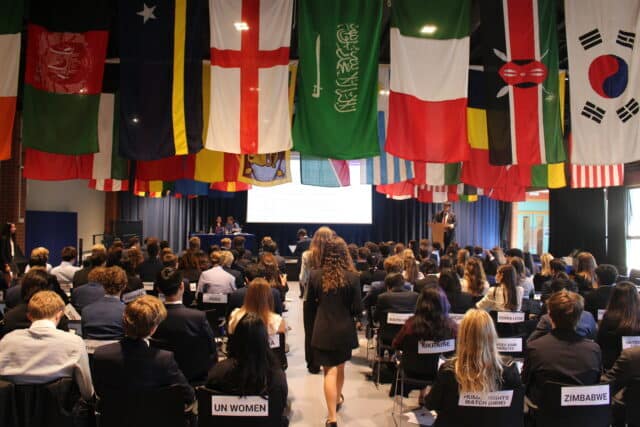
Rudra’s achievements at ACS Hillingdon have extended well beyond his academic results. He has served as President of the National Honour Society, chaired and won accolades at Model United Nations conferences, and was selected as one of 400 students globally to serve as a student advocate for a leading financial daily. He has also conducted research with Harvard professors through the Cambridge Centre for International Research (CCIR) programme and taken leading roles in the school’s musicals.
Together, Tanisi and Rudra illustrate two very different approaches to the transition from school to university: one student with a clear academic and career direction, and another who deliberately chose breadth and exploration before deciding where his interests would take him.
Their results form part of a strong year for the IB Diploma at ACS Hillingdon. Almost every Hillingdon student who sat the IB Diploma this summer gained the full Diploma, a pass rate of 97 per cent. The year group averaged 37 points, against a world average of 30 – the equivalent of three A* at A-level on the school’s comparison scale. The school’s highest score was 45 out of 45, a perfect score achieved by fewer than one per cent of students worldwide.
Not every Hillingdon student takes the full Diploma. The school also offers the IB Career-related Programme, which pairs a career focus with two or three of the Diploma’s Higher Level subjects. Every student on the programme passed this year and all achieved at least a 5 out of 7 in each of their Higher Level subjects.
Hillingdon also offers the Advanced Placement (AP) programme, which lets a student specialise rather than spread across six subjects. This year 22 Hillingdon students sat AP exams, scoring an average of 3.6 out of 5, and more than 91% scored 3 or above, well above the world average for these rigorous, University-level courses.
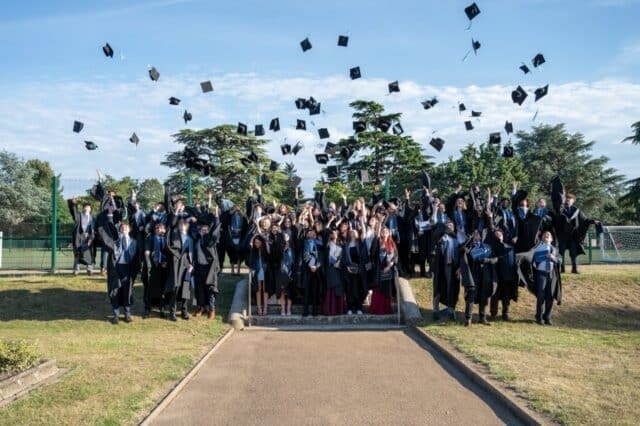
The ‘Class of 2026’ are heading to UK universities including Imperial College London, King’s College London, LSE, Bath, Exeter and St Andrews. Others are going further afield – McGill in Canada, the University of Melbourne in Australia, ESCP Business School in France, the Hong Kong University of Science and Technology, Bocconi in Italy, IE University in Spain, and, in the United States, Babson College, Boston University and the University of Arizona.
Martin Hall, Head of School at ACS Hillingdon, said the results should make people think harder about how schools are judged.
He explained that: “There is a national habit of measuring a school by its A-level grades alone.
But the people who pick university students are looking for something broader. In a survey of 65 admissions officers we published this year, a large majority said the IB Diploma – not A-levels – is the best preparation to thrive at university, and they now rate what a student knows as being no more important than what they can do with it. Both students are case in point. They have run their own initiatives, led teams and managed their time, and they have the grades too. That is what universities tell us they now depend on, and we do it without selecting a single child on ability.”
That survey, the University Admissions Officers Report 2026, was carried out for ACS International Schools with the IB Schools and Colleges Association. It found the IB Diploma rated 23 per cent higher than A-levels across the skills universities say they now want most, including independent research and the ability to manage competing deadlines.
I chose the IB because I wanted something challenging that would prepare me for university, and I liked that I didn’t have to narrow my studies too early. Balancing The Hawk Eye, volleyball and the National Honour Society with the demands of the IB wasn’t always easy, but it taught me to plan ahead, prioritise and ask for help when I needed it. Looking back, those experiences made me much more resilient.